
Turn unpaid invoices
into working capital
Get the cash you need earlier instead of waiting through long customer payment terms. Eligible businesses can access working capital against unpaid B2B invoices, subject to assessment and financing partner terms, across the UAE and India.
Indicative upfront working capital against an eligible invoice.
Illustrative example only. Actual advance amount, pricing and eligibility depend on assessment and financing partner terms.
See how an invoice becomes working capital
A quick walkthrough of our platform interface and the rapid approval process.
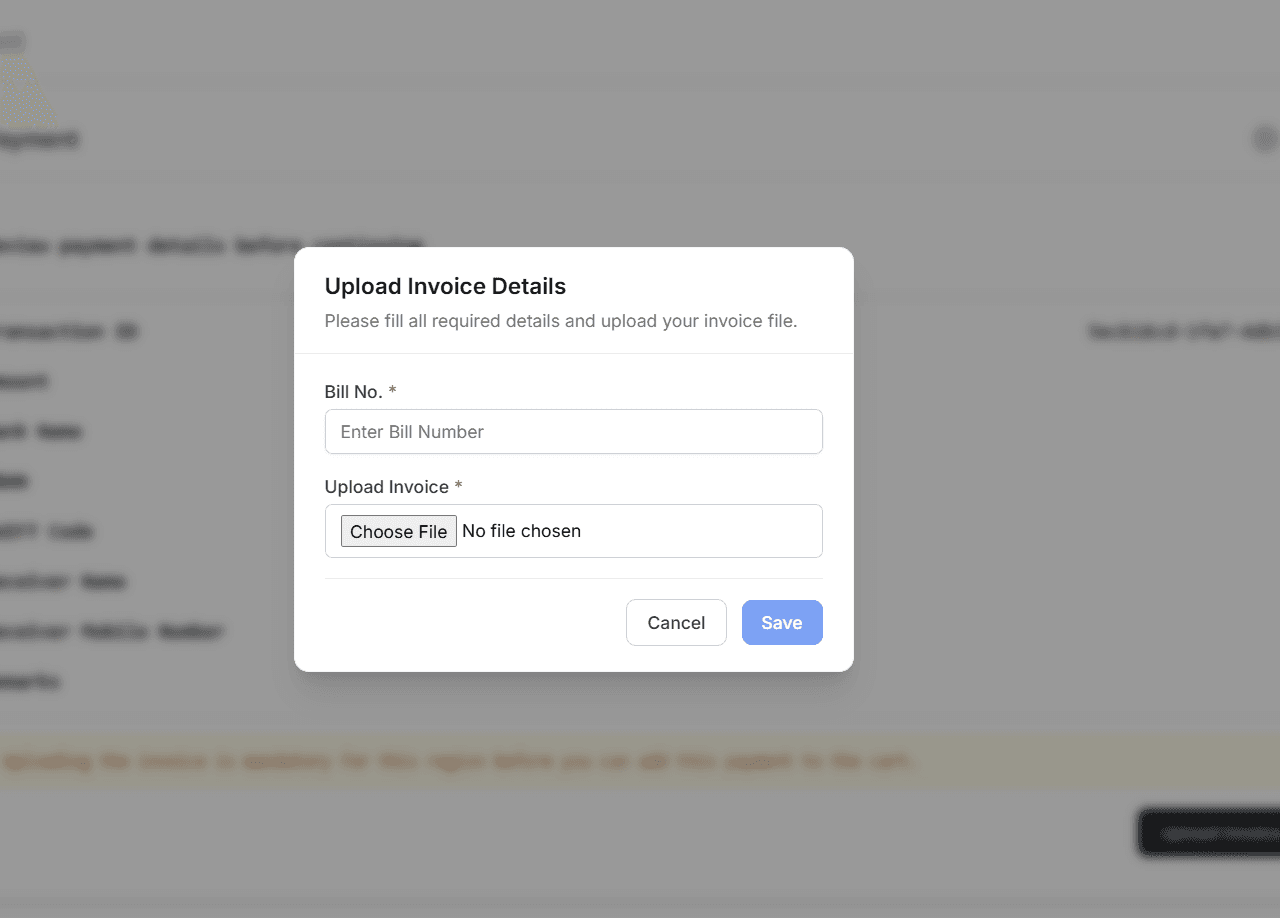
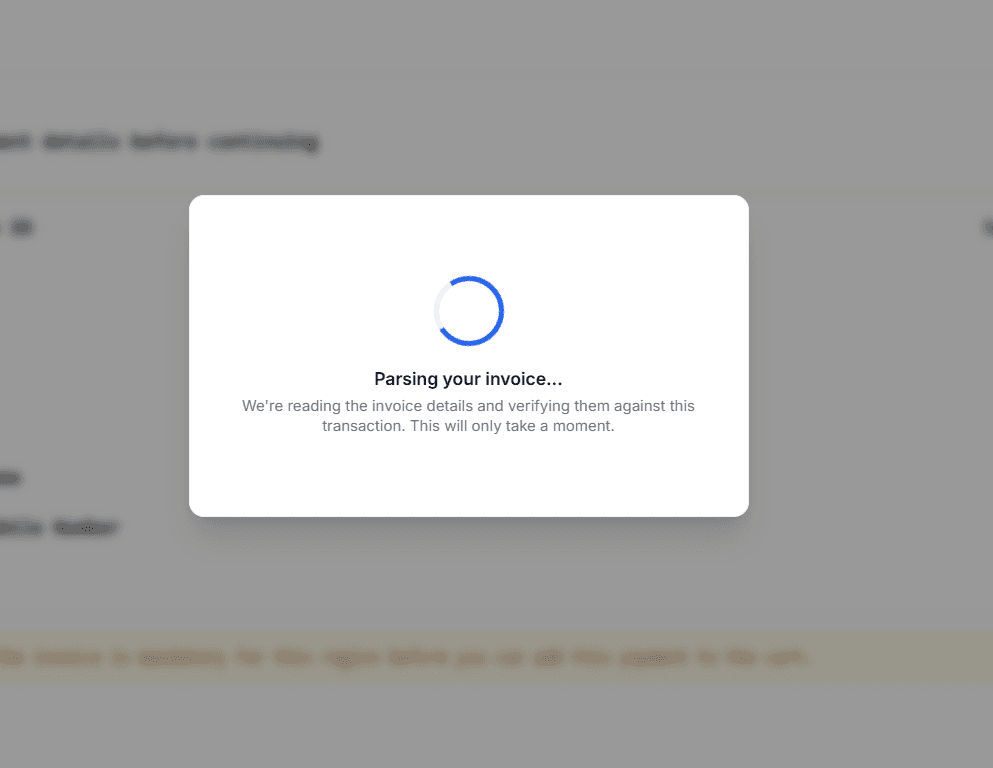
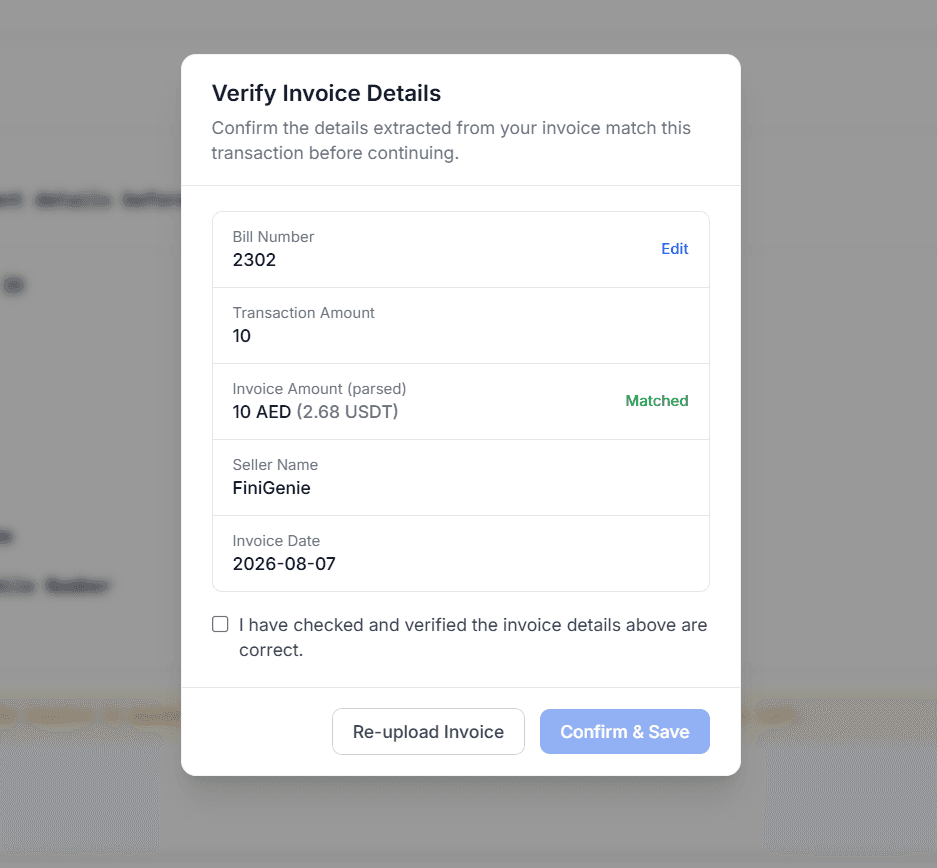
Upload your invoice
The cost of waiting.
Every extra day of payment terms is cash your business can't use.
Fulfil more orders
Stop declining opportunities due to cash gaps and grow your business faster.
Pay suppliers on time
Avoid late fees and strengthen supply chain relationships with reliable cash flow.
How it works — seller journey.
From raising an invoice to getting paid — five steps, fully tracked.
- 1
Raise invoice
- 2
Submit with documents
- 3
Invoice & buyer verified
- 4
Financing partner releases advance
- 5
Customer pays on due date, balance settled
Economics — worked example.
A simple, illustrative breakdown of how invoice discounting turns an unpaid invoice into cash today.
Transaction Summary
- Invoice value
- ₹10,00,000
- Payment term
- 90 days
- Advance rate
- 85%
- Discount charge
- ₹17,500
- Balance released on settlement
- ₹1,32,500
- Total received
- ₹9,82,500
Annualized equivalent rate: ~7% p.a.
Indicative example only — actual rates vary by invoice risk and tenor.
What is invoice discounting?
Invoice discounting is a financing facility where a business uses its unpaid invoices as collateral to access working capital. It allows you to draw a significant percentage of the invoice value immediately, rather than waiting for the customer to pay on their standard terms.
Advance rate: 70–90% typical
Financing partners typically advance the majority of the invoice value upfront.
Recourse vs non-recourse
Choose whether you or the funder carries the risk of customer non-payment.
Disclosed vs confidential
Opt to keep the financing arrangement private from your customers.
Discounting vs factoring
Understand the difference between ledger management and invoice financing.
What acceleration is worth
What could you earn (or avoid) by having ₹9,50,000 available 90 days earlier?
Estimated opportunity: ~₹42,164 over 90 days at redeployment.
Illustrative only, based on a 18% p.a. redeployment rate — not a rate offer.
Overdraft
Better when you have consistent, predictable short-term cash gaps.
Cash credit limit
Better when you need a revolving facility tied to inventory.
Term loan
Better when you need long-term capital for expansion or equipment.
Delaying supplier payment
Better when relationships allow, though it risks supply chain stability.
Choose your route
Four answers to different questions.
| Invoice Discounting | Early Payment Financing | Supply Chain Finance | Card-Based Vendor Payment | |
|---|---|---|---|---|
| Who gets cash early | Seller | Seller | Supplier | Supplier |
| Whose balance sheet funds it | Seller's receivable | Buyer or Funder | Third-party Funder | Buyer's credit facility |
| Choose it when… | You need cash now against your own invoices | You want to offer early payment for a discount | You want to support suppliers using your credit | You want to extend DPO while paying suppliers |
What kind of invoice discounting is actually available?
Understanding the 5 common mechanisms used to accelerate cash flow.
Invoice Discounting (Receivables Discounting)
You sell or assign your receivables and draw a 70–90% advance against them.
Funded by: Seller's receivableFactoring
The financing partner takes over collections directly from your customers.
Funded by: Funder — customer notifiedEarly Payment Financing / Dynamic Discounting
The buyer, or a funder acting on the buyer's behalf, pays early in exchange for a discount.
Funded by: Buyer or FunderSupply Chain Finance / Payable Finance
A third-party funder pays suppliers early, priced off the buyer's credit rating.
Funded by: Third-party FunderCard-Based Vendor Payment
The buyer settles via a commercial credit limit or corporate card.
Supplier invoice → Buyer's commercial credit limit → Supplier paid early → Buyer settles card
Settlement is extended by the card network — not external funding.
Funded by: Buyer's credit facilityPaying suppliers early, without spending your own cash
- Invoice
- ₹10,00,000
- Term
- 45 days
- Reduction
- 1%
- Supplier receives
- ₹9,90,000
~8.1% annualised return
Note: interest-free periods apply to specific structures only.
How invoice discounting plays out by sector
Logistics & Transport
Fuel/wages weekly vs 45–90 day freight invoices. Financing proof-of-delivery invoices.
Docs: e-way bill, POD, GST invoice
Illustrative — confirm sector specifics with Finigenie.
Manufacturing
Upfront raw materials/labour vs 60–120 day terms. Bridges the gap.
Docs: PO, GRN, tax invoice
Illustrative — confirm sector specifics with Finigenie.
Import/Export & Trading
Shipping/customs vs 60–180 day open-account terms. Releases cash against shipped receivables.
Docs: BL, commercial invoice, customs declaration
Illustrative — confirm sector specifics with Finigenie.
Wholesale
Stock purchased upfront vs 30–90 day dealer credit terms. Frees up cash tied in inventory turnover.
Docs: Purchase invoice, delivery challan, GST invoice
Illustrative — confirm sector specifics with Finigenie.
Construction
Labour and material costs upfront vs 60–120 day milestone billing cycles. Smooths project cash flow.
Docs: RA bill, work completion certificate, tax invoice
Illustrative — confirm sector specifics with Finigenie.
Staffing
Payroll runs biweekly or monthly vs 30–60 day client payment terms. Covers the wage-to-invoice gap.
Docs: Timesheet, staffing invoice, purchase order
Illustrative — confirm sector specifics with Finigenie.
IT
Development costs upfront vs 45–90 day enterprise client payment cycles. Bridges the delivery-to-payment gap.
Docs: SOW, milestone invoice, acceptance certificate
Illustrative — confirm sector specifics with Finigenie.
Healthcare
Supplies and staffing costs upfront vs 60–120 day insurer/TPA reimbursement cycles. Eases claims-cycle strain.
Docs: Claim invoice, service record, TPA approval
Illustrative — confirm sector specifics with Finigenie.
Food & FMCG
Raw materials and distribution costs upfront vs 30–60 day retailer/distributor credit terms. Supports inventory cycles.
Docs: Delivery note, GST invoice, purchase order
Illustrative — confirm sector specifics with Finigenie.
Eligibility
Usually a good fit
- B2B sales with 30–90 day terms
- Strong buyer credit profiles
- Delivered goods / completed services
Usually not a fit
- B2C retail sales
- Highly conditional or milestone-based contracts
- Severe financial distress
How Finigenie fits alongside TReDS in India
TReDS acts as a public utility designed to facilitate the financing of trade receivables of MSMEs from corporate buyers through multiple financiers.
MSME seller
Must be registered MSME.
Buyer onboarded
Buyer must accept obligation.
Domestic only
India-to-India transactions.
Funds receivables only
Pure financing mechanism.
How invoice financing works in the UAE
Understanding the legal framework, export/cross-border nuances, and working with licensed partners in the Emirates.
Bank vs fintech vs buyer-led
Multiple ecosystem players.
Sharia-compliant pending confirmation
Islamic finance options.
India-UAE corridor
Seamless cross-border trade.
What else is out there…
Regulated utilities
e.g. India/TReDS
Traditional banks
Legacy systems
Single-mechanism fintechs
e.g. UAE specific
Finigenie
Orchestration layer
“The question isn't which platform is cheapest… it's which mechanism fits your specific working capital cycle.”
For CFOs
DIO + DSO − DPO
Non-recourse derecognises receivables (DSO falls). With-recourse stays on books.
Confirm with auditor.Balance Sheet Impact
On balance sheet
Off balance sheet
Why Finigenie
Multiple routes, one app
Access diverse funding pools through a single interface.
Transaction record
Immutable history of all your financing activities.
One profile, India/UAE
Unified identity for cross-border operations.
Finigenie vs TReDS vs Bank
| Attribute | Finigenie | TReDS | Bank |
|---|---|---|---|
| Who can be seller | Any | MSME only | Varies |
| Buyer acceptance | Flexible | Mandatory | Mandatory |
| Financiers competing | Yes | Yes | No |
| Geo | Cross-border | Domestic | Mostly Domestic |
| Recourse | Both | Non-recourse | Usually With-recourse |
| Collateral | None | None | Often Required |
| Onboarding | Digital/Fast | Standard | Lengthy |
| Time to funds | 24–48 hours | Fast | Weeks |
| Pricing | Competitive | Market | Fixed |
| Best suited to | Agile businesses | Domestic MSMEs | Large Corporates |
Working Capital Estimator
Released upfront
₹8,50,000
Cost
₹37,479
Balance
₹1,12,521
Total
₹9,62,521
Indicative only — not a rate offer.
Trusted by




Got Questions?
Everything you need to know about Finigenie. Can't find the answer? Talk to our team.
Invoice discounting is a financing facility where a business uses its unpaid invoices as collateral to draw a significant percentage of the invoice value immediately — typically 70–90% — rather than waiting for the customer to pay on standard terms.
An overdraft or cash credit limit is a revolving facility tied to your overall credit line, and a term loan is long-term capital for expansion or equipment. Invoice discounting is tied specifically to individual invoices, with funds released against verified receivables — typically faster to access and without requiring the same collateral as a traditional bank loan.
It depends on the structure. Non-recourse invoice discounting derecognises the receivable from your balance sheet, causing Days Sales Outstanding (DSO) to fall, since the financier bears the risk of non-payment. With-recourse invoice discounting keeps the receivable on your books, since your business remains liable if the customer doesn't pay. Confirm the specific accounting treatment with your auditor.
Yes. Finigenie supports invoice discounting across both India and the UAE, including cross-border transactions through the India-UAE corridor, with region-specific compliance — TReDS-aligned processes in India and DFSA/FSRA-regulated, Factoring Law-compliant structures in the UAE.
TReDS is a public utility in India limited to MSME sellers, mandatory buyer acceptance, and domestic-only transactions. Finigenie works with any seller, offers flexible buyer acceptance, supports both recourse and non-recourse structures, and enables cross-border financing between India and the UAE — with digital onboarding and funds typically released in 24–48 hours.
Invoice discounting works well for any business with a cash-timing mismatch between costs and customer payment terms — commonly logistics and transport, manufacturing, import/export and trading, wholesale, construction, staffing, IT, healthcare, and food and FMCG businesses with B2B receivables.
Businesses are usually a good fit if they have B2B sales with 30–90 day payment terms, strong buyer credit profiles, and invoices for delivered goods or completed services. It's usually not a fit for B2C retail sales, highly conditional or milestone-based contracts, or businesses in severe financial distress.
Once an invoice and buyer are verified, approved invoices are typically funded within 24–48 hours. Full onboarding for a new business typically takes 2–3 days.
The cost is calculated using the indicative annualised rate applied to the invoice value for the number of days until the payment term is settled. For example, on a ₹10,00,000 invoice with a 90-day term at an indicative rate, the discount charge is deducted from the retained balance, with the remainder released once your customer pays.
Documentation depends on the sector, but commonly includes the invoice itself, proof of delivery or completion, and a purchase order. For example, logistics businesses typically need e-way bills, proof of delivery, and GST invoices, while import/export businesses typically need a bill of lading, commercial invoice, and customs declaration.
Calculate Your ROI
Make informed investment decisions with our advanced ROI calculator.

Calculate Your ROI
Make informed investment decisions with our advanced ROI calculator.